
Strength after 60
Strength training that knows you're over 60.
About 1 in 4 adults over 65 fall each year.8,9 The guidelines' answer: train balance and strength.20,21
Diagnosed with osteoporosis or osteopenia? That changes the rules.
Your programme knows your age and adjusts by itself, kinder on your joints in every phase.

- Never lifted? Start seated, or holding on to a chair: tell it, and your plan starts where you're steady.
- Older? Your plan adapts to your age by itself, kinder on your joints.
- Free balance and strength checks that show where you stand for your age.
VeraForma is coaching, not medicine. It does not diagnose, treat or cure anything. Check with your doctor before you start, especially if you have a heart condition, high blood pressure, diabetes, osteoporosis, arthritis or a recent injury.
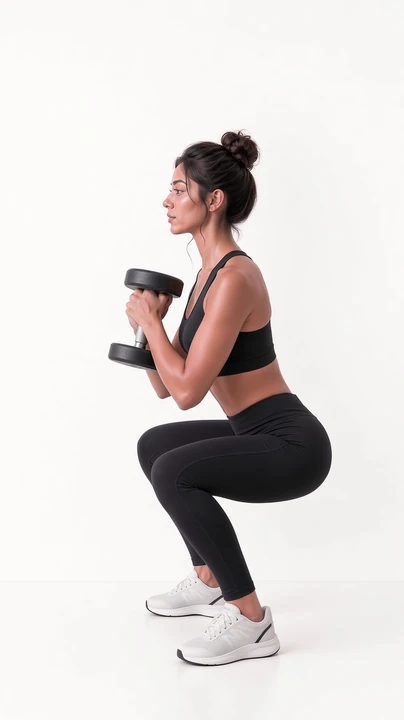
The line, drawn on the body. The angles, measured on the rep itself.
This demonstration features a synthetic performer: Merissa, VeraForma's AI-generated fitness model.
What the years take
Muscle fades quietly. Strength fades faster.
3 to 8% of your muscle goes every decade from your 30s, and faster after 60.1,2
2 to 5 times faster: that is how much quicker strength goes than muscle, in a 2012 review.2 In a separate study, knee strength fell 14 to 16% a decade even where muscle held.3
60 is when your metabolism, steady since your 20s, starts to slow, in a 2021 study in Science.4 It drops further in old age.5
Up to 20% of their bone density: what some women lose in the five to seven years after menopause, according to the Bone Health & Osteoporosis Foundation.6,7
“My bones are thin. Lifting will break me.” Tell it once.
Low bone density? Your plan is built around it, from the first session.
In or past menopause? Tell it, and your programme is built for your bones.
Check with your doctor before you start a new exercise programme, especially with osteoporosis.
FreeThen it takes one fall.
- About 1 in 4 adults over 65 fall each year.8,9
- Most broken hips in older adults come from a fall.10,11
- Many people who break a hip never walk the way they did before. In a review of 38 studies, only 40 to 60% got back the mobility they had.12,13
- After 65, about 1 in 5 women who break a hip die within a year, and men fare worse.14-16
- The raised risk of dying lasts for years after a broken hip.16,17
- Women over 50 are nearly twice as likely as men to break a bone from weak bones. But men who break a hip are more likely to die after it.14,16,18,19
The answer
The guidelines' answer: train balance and strength.
The US physical activity guidelines and the World Health Organization both tell older adults to train balance and strength, as well as cardio.20,21
And strength training still adds muscle and strength in older adults.22,23
In trials, exercise programmes built on balance and functional training cut falls by about a quarter.27,28
Your programme knows your age, and it adjusts by itself.
Built for 60 and over
Built for the years you have. It adjusts by itself.
Training around: Over 60
Lighter and longer, on purpose.
Your age is part of your evaluation, and your plan adapts to it by itself.
“I don't want an old person's workout.” You won't get one. The same full programme everyone gets, built around the years you have.
Free-
What changes for you.
Kinder on your joints, in every phase.
Every lift is pitched kinder on your joints, in every phase, the strength phase included.
“I'll get hurt.” Every lift is gentler, in every phase.
Free + Premium -
Steady on your feet.
Phase 1 is free for as long as you want it.
Unsteady on your feet? Tell it once, and your balance work starts where you're steady.
Need something to hold? Your plan meets you there. Train beside a sturdy chair or a wall.
“My balance isn't what it was.” Then tell it, and your plan starts where you're steady.
Free -
Know where you stand.
Simple balance and strength checks at home show you where you stand for your age.
“How would I even know?” Try the checks, and see where you stand.
Free -
Need to hold on? That's a programme too.
Can't train standing? Choose a seated programme.
Your plan starts where you're steady, with something to hold.
“I can't get down on the floor.” You don't have to. In the app's words: “Seated is a real programme, not a lesser one.”
Free -
Your doctor first, when it matters.
When your answers call for a doctor's OK, your plan waits for it, already built, and you train the day you have it.
“My doctor handles my health.” Good. Your doctor stays in charge, and your plan is ready the day they say go.
Free -
A camera that watches your set.
Prop your phone up. The camera watches your set, names what it sees with the number it measured, and draws the line on your body. With Premium, it speaks the fix while you move.
“Nobody's there to check my form.” After each set you get the fault, the fix, the worst reading, and a photo of the rep where it happened.
Free + Premium
Phase 1, the over-60 adjustments and the tests: free.
Stiff joints, sore knees
Joints that ache? It trains around them.
Joint pain: train around it, and correct what's behind it. Every workout works around the old injury; Premium's Muscle Balance Program corrects the imbalance behind it, which can alleviate the pain.
-
Tell it once.
Achy joints? Your workouts are built to be kind to them.
Mark an old injury once on your evaluation, and the programme trains around it.
“My knees already hurt.” Tell it once. Every workout after that is built around them.
VeraForma is coaching, not medicine. It does not diagnose, treat or cure anything. Check with your doctor before you start.
Free -
Stiff? It's built into every session.
Loosening up is part of every session.
At the end of your evaluation, see your findings on your own 3D body: what is tight, what is weak.
What the screen finds is what your warm-up works on: release what's tight, wake up what's weak (Premium).
“I'm too stiff to start.” Stiff is where the screen starts: it shows you what's tight, free.
Free + Premium
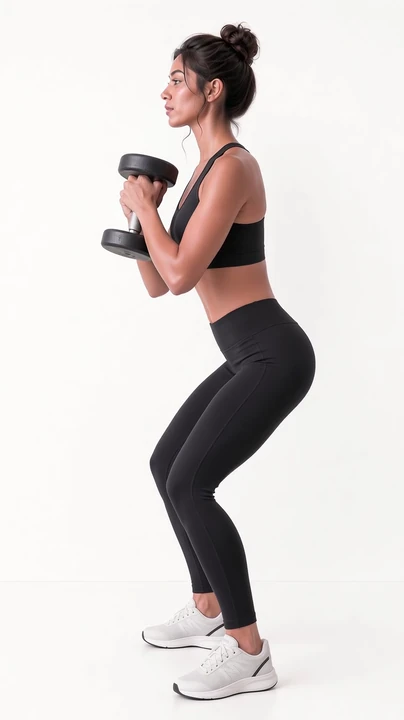
Your kit, your living room.
Built around the kit you have: a full gym, dumbbells, bands, or nothing at all.
“I'm not a gym person.” You don't need to be. A programme built around your week: 2 to 7 days, sessions of 20, 30 or 45 minutes, an hour or no limit, at your level.
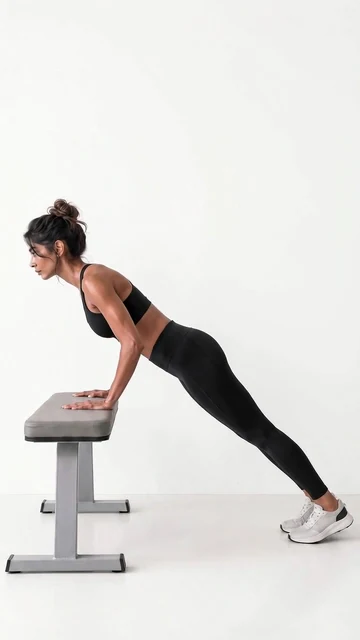 Bench push-up
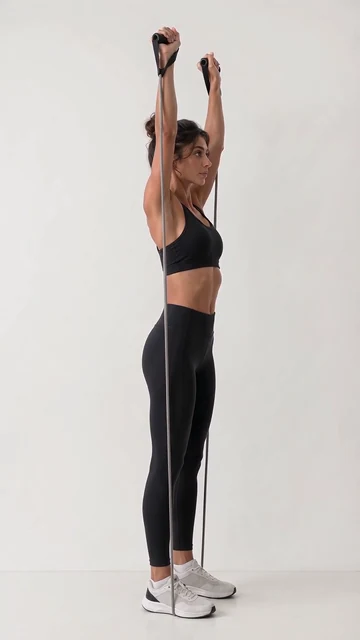 Band shoulder press
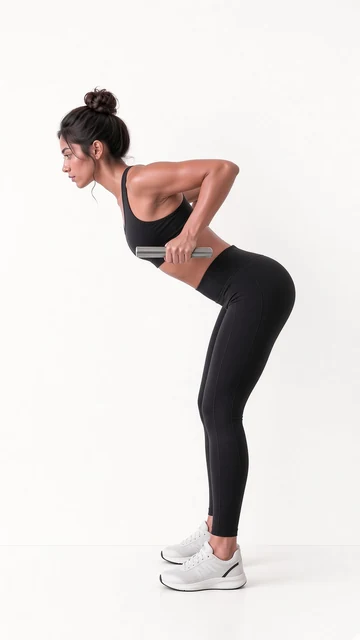 Dumbbell row
A few of the moves in the library, demonstrated by Merissa. This demonstration features a synthetic performer: Merissa, VeraForma's AI-generated fitness model.
Food after 60
Calories sized to your age. Calcium and vitamin D targets that rise with it.
Your metabolism holds steady from your 20s to 60, then it starts to slow, in a 2021 study in Science.4 So your food has to keep up.
-
Calories that know your age.
Your calorie target keeps up with your age, so your food keeps up with your metabolism.
Calorie and protein targets built for your body, that keep up with your real progress and show you why they moved.
“I eat less than ever and still gain.” Then your target keeps up with your real progress, not an average.
Free -
Calcium and vitamin D, by the book.
Calcium and vitamin D targets made for your age.
Free -
Protein, spread through the day.
Experts on older adults advise at least 1.0 to 1.2 g of protein per kg of body weight a day.24,25 VeraForma gives you a daily protein target sized to your body.
Thinking about fasting? Past sixty, holding on to muscle depends more on spreading protein through the day than on when you start eating.
In or past menopause? Tell it, and your food and your programme are built for your bones.
Kidney disease? Ask your doctor what protein target is right for you.
Free -
A meal plan you can change.
A free meal plan built from your numbers and your training: real recipes, sized to your targets. Swap any food or rebuild it any time.
“I don't know what I should eat now.” Start with the plan. Your whole nutrition programme is free.
Free
Free and Premium
Start free. Stay as long as you like.
Free, for good
- Every over-60 adjustment, free.
- Phase 1, for as long as you want it, with balance built in.
- The balance and strength checks.
- A cardio plan that fits around your lifting days.
- Unlimited movement screens.
- Your whole nutrition programme: targets, meal plan, barcode scanner.
Premium adds
- Every phase after Phase 1, rebuilt from your latest screen, with your adjustments still on.
- Your corrective programme, with the techniques and doses.
- The coach speaks the fix while you move.
Premium: $29.99 a month, or $249.99 a year (save 30%).
A trainer once a week runs about $238 a month. Premium is with you every workout, not one hour a week.
Get Premium here with a card, or in the Android app through Google Play.
Built by Brad Glaser · NASM Master Trainer · NASM-CPT, CES, PES · 20+ years · has certified 100+ personal trainers.
He owns a personal-training studio in Southern California. The same method he uses standing next to a client, built into the app.
Questions
Straight answers.
I'm too old to start.
I'm afraid I'll get hurt.
Every lift is pitched kinder on your joints, in every phase, the strength phase included.
Low bone density? Your plan is built around it, from the first session.
When your answers call for a doctor's OK, your plan waits for it, already built, and you train the day you have it.
My back already hurts.
Mark your low back once, and the programme trains around it.
Sore today? Tell it, and today's session trains around it, or tells you it is one for a doctor or physio first.
VeraForma is coaching, not medicine. It does not diagnose, treat or cure anything, and it does not replace your doctor or physio.
My doctor handles my health.
Good, keep it that way. When your answers call for a doctor's OK, your plan waits for it, already built, and you train the day you have it.
Check with your doctor before you start a new exercise programme.
I don't have an hour.
A programme built around your week: 2 to 7 days, sessions of 20, 30 or 45 minutes, an hour or no limit, at your level.
Short on time? Pick 15, 20 or 30 minutes and see today's trimmed list before you start.
Is it for men too?
Yes. Man or woman, your plan adapts to your age by itself.
Women over 50 are nearly twice as likely as men to break a bone from weak bones. But men who break a hip are more likely to die after it.14,16,18,19
What does it cost?
Free: every over-60 adjustment, Phase 1 for as long as you want it, the tests, and your whole nutrition programme.
Premium: $29.99 a month, or $249.99 a year (save 30%).
A trainer once a week runs about $238 a month. Premium is with you every workout, not one hour a week.
Get Premium here with a card, or in the Android app through Google Play.
Is the camera private?
The camera reads you on your phone. Your form-check video stays on your phone unless you choose to send it.
No advertising, no outside analytics, no trackers. We do not sell your data.
Android, web or iPhone?
All three.
Get the Android app on Google Play. On an iPhone or a computer, open veraforma.app in your browser and start today.
The App Store app is in Apple's review.
Do I need an account?
Yes, a free one, and no card. Your training, your food and your screen results sync to it.
VeraForma is coaching, not medicine. It does not diagnose, treat or cure anything, and it does not replace your doctor or physio. Check with your doctor before you start a new exercise programme, especially if you have a heart condition, high blood pressure, diabetes, osteoporosis, arthritis or a recent injury.
Sources
- Muscle mass “decreases approximately 3–8% per decade after the age of 30” and faster after 60. Volpi E, Nazemi R, Fujita S. Muscle tissue changes with aging. Curr Opin Clin Nutr Metab Care 2004. Read it.
- Median muscle loss 3.7% a decade in women and 4.7% in men; strength lost 2-5 times faster than muscle. Mitchell WK et al. Front Physiol 2012;3:260. Read it.
- Knee strength fell 14-16% a decade, even where muscle held. Hughes VA et al. J Gerontol A 2001. Read it.
- Daily energy use, adjusted for body size, “remains stable in adulthood (20 to 60 years)”, then declines. Pontzer H et al. Science 2021. Read it.
- Manini TM. Energy expenditure and aging. Ageing Res Rev 2010. Read it.
- Bone Health & Osteoporosis Foundation, What Women Need to Know: up to 20% of bone density in the five to seven years after menopause. Read it.
- US Office on Women's Health, Osteoporosis: some women lose “up to 25% of bone mass in the first 10 years after menopause”. Read it.
- 27.6% of adults 65 and over reported a fall in the past year (2020). Kakara R et al. MMWR 2023;72:938. Read it.
- 23.4% of adults 65 and over living independently reported a fall (National Health and Aging Trends Study). Innov Aging 2024. Read it.
- 88% of emergency visits and hospital stays for hip fractures are caused by falls. CDC, Facts About Older Adult Falls. Read it.
- “In 98% of the hip fracture patients, the fracture was a result of a fall.” Parkkari J et al. Calcif Tissue Int 1999. Read it.
- 40-60% recovered their pre-fracture mobility. Dyer SM et al. A critical review of the long-term disability outcomes following hip fracture. BMC Geriatr 2016. Read it.
- Magaziner J et al. Recovery from hip fracture in eight areas of function. J Gerontol A 2000. Read it.
- US Medicare, 65 and over: risk-adjusted one-year mortality after a hip fracture of 21.9% in women and 32.5% in men (2004). Brauer CA et al. JAMA 2009. Read it.
- 22.8% of women 65 and over died within 12 months of a hip fracture. Lo JC et al. Am J Manag Care 2015. Read it.
- Excess mortality after hip fracture, higher in men than in women. Haentjens P et al. Ann Intern Med 2010. Read it.
- Adults 60 and over: raised mortality risk “persisted for 5 years for all fractures and up to 10 years for hip fractures”. Bliuc D et al. JAMA 2009. Read it.
- About 1 in 2 women and up to 1 in 4 men over 50 will break a bone due to osteoporosis. Bone Health & Osteoporosis Foundation, General Facts. Read it.
- 1 in 3 women and 1 in 5 men over 50. International Osteoporosis Foundation, Epidemiology. Read it.
- Older adults should do “multicomponent physical activity that includes balance training as well as aerobic and muscle-strengthening activities”. US Physical Activity Guidelines for Americans, 2nd edition, 2018. Read it.
- Older adults: “functional balance and strength training at moderate or greater intensity on 3 or more days a week”. Bull FC et al. World Health Organization 2020 guidelines. Br J Sports Med 2020. Read it.
- Peterson MD et al. Influence of resistance exercise on lean body mass in aging adults: a meta-analysis of 49 studies. Med Sci Sports Exerc 2011. Read it.
- Fragala MS et al. Resistance training for older adults: position statement from the National Strength and Conditioning Association. J Strength Cond Res 2019. Read it.
- Bauer J et al. Optimal dietary protein intake in older people: PROT-AGE Study Group. J Am Med Dir Assoc 2013. Read it. It also says older people with severe kidney disease may need to limit protein.
- Deutz NE et al. Protein intake and exercise for optimal muscle function with aging: ESPEN Expert Group. Clin Nutr 2014. Read it.
- Institute of Medicine (National Academies). Dietary Reference Intakes for Calcium and Vitamin D, report brief, 2010. Read it.
- Exercise programmes cut the rate of falls by 24%. Sherrington C et al. Cochrane review, exercise for preventing falls, 2019 (PMID 30703272). Read it.
- US Preventive Services Task Force, Falls Prevention in Community-Dwelling Older Adults: Interventions (2024): exercise to prevent falls in adults 65 and over, grade B. Read it.
Strength training that knows you're over 60. Start free.

Scan to open it on your phone.
Free account, no card. Brad's questions. One squat on camera. Then your results.
VeraForma is coaching, not medicine. It does not diagnose, treat or cure anything. Check with your doctor before you start, especially if you have a heart condition, high blood pressure, diabetes, osteoporosis, arthritis or a recent injury.