

Injury Coach

Most joint pain starts with a muscle imbalance.

It finds yours free, trains around the pain, and Premium corrects it.

QR code that opens veraforma.app

Scan to open it on your phone.

Free to start.

VeraForma is coaching, not medicine. It does not diagnose, treat or cure anything, and it does not replace your doctor or physio.
  • Train on an imbalance and every rep reinforces it.
  • Left alone, it feeds what NASM calls the cumulative injury cycle, which “causes decreased performance and eventual injury.”1
  • Pro soccer players with an untreated hamstring strength imbalance had 4.66 times the rate of hamstring strains.3
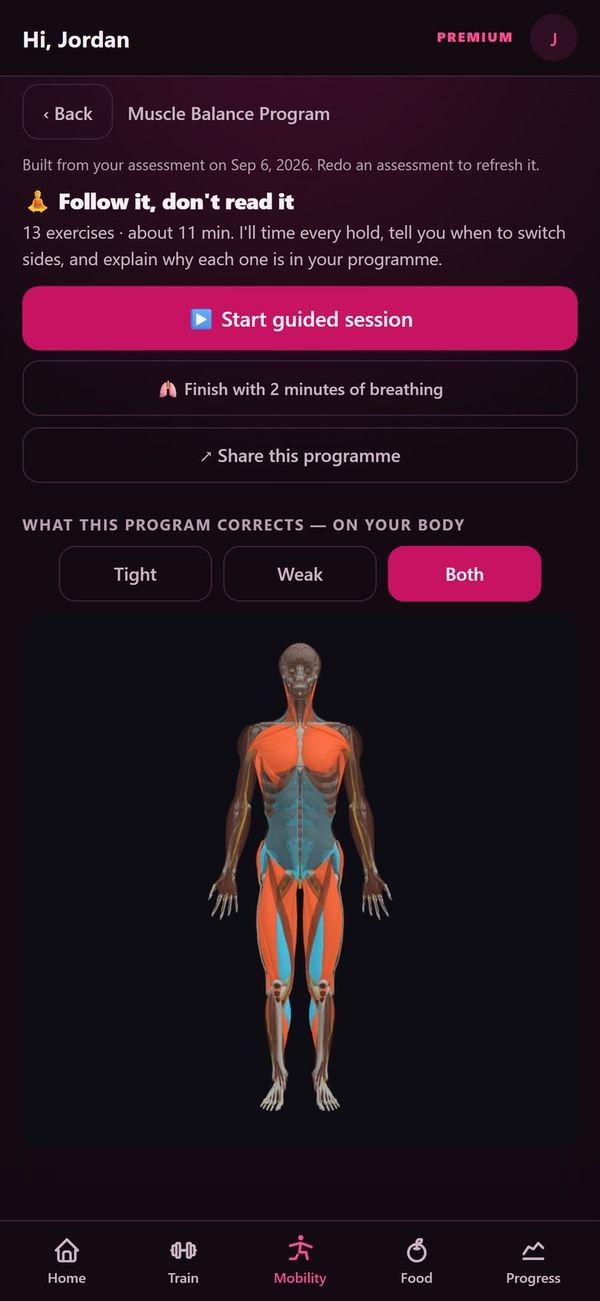
The Muscle Balance Program screen on a demo account: a 3D body with its tight and weak muscles coloured.

Real screen from the app (demo account): the Muscle Balance Program. Premium

How a muscle imbalance works

One side pulls. The other lets go. The joint takes the strain.

  1. One muscle stays tight. It works overtime and keeps pulling.
  2. The muscle on the opposite side goes weak. It stops pulling its weight.
  3. The joint between them is pulled out of line. Every rep now loads it the wrong way.

Keep training on that pattern and every rep drives the cumulative injury cycle round again, worsening the imbalance until something gives.

Illustration: a muscle imbalance at a joint Two bones meet at a joint. On the left, a short, thick muscle is tight and keeps pulling. On the right, a long, slack muscle is weak and lets go. The lower bone is pulled out of line, away from where it should sit, shown as a dashed outline. Illustration only. ILLUSTRATION Tight Weak keeps pulling lets go Pulled out of line
A muscle imbalance. One side tight, the other weak, the joint between them pulled out of line. Illustration.

Have any of these?

Your screen names the imbalance. See the pain that commonly comes with it.

One squat on camera and your free movement screen names the imbalances in how you move. Beside each one, the pains that commonly come with it.5

  • Feet and ankles

    Your screen names

    • Feet turn out
    • Feet flatten
    • Heels rise

    Commonly comes with

    • Plantar fasciitis
    • Shin splints
    • Jumper's knee
  • Knees

    Your screen names

    • Knees move inward
    • Knees bow outward

    Commonly comes with

    • Knee pain at the front, inside or outside
    • IT band pain
  • Hips and low back

    Your screen names

    • Excessive forward lean
    • Low back arches
    • Low back rounds

    Commonly comes with

    • Hamstring, quad and groin strains
    • Low back pain
  • Side to side

    Your screen names

    • Weight shifts to one side

    Commonly comes with

    • Hamstring, quad and groin strains
    • Low back pain
    • SI joint pain
  • Shoulders

    Your screen names

    • Arms fall forward

    Commonly comes with

    • Headaches
    • Biceps tendonitis
    • Shoulder injuries

The pains are the possible injuries NASM lists beside each pattern in its movement assessment.5

VeraForma is coaching, not medicine. It does not diagnose, treat or cure anything, and it does not replace your doctor or physio.

Where you are

Do you know where your muscle imbalances are?

  • Your muscle imbalances?
  • Your body fat %?
  • Your BMI?
  • Which training phase you're in?

VeraForma shows you where you are, where you should be, and moves you there.

  • Body fat. Your reading on Brad's own chart for your age, with where you should be marked.
  • BMI. Where you sit, told straight: BMI can't tell muscle from fat, so your body fat sits beside it.
  • Muscle imbalances. Your movement screen names your imbalances, the way a trainer would.
  • Your phase. All six phases, with “You are here” on yours.

Your first reading stays on the bar beside your latest, so you see how far you've moved.

See your progress →
Illustration: where you are, where you should be Three bars, not a real member's numbers. Body fat for your age: Ideal, Lean, Average, Above average and Overfat, with Ideal to Average marked where you should be; a first reading in Above average and you now in Average. BMI: Underweight, Healthy, Overweight and Obese, with you in Overweight, and the note that BMI can't tell muscle from fat, so your body fat sits beside it. Your phase: six phases with You are here on phase 2. ILLUSTRATION · NOT A REAL MEMBER Body fat, for your age You First Ideal Lean Average Above avg. Overfat WHERE YOU SHOULD BE BMI You Underweight Healthy Overweight Obese BMI can't tell muscle from fat, so your body fat sits beside it. Your phase 123456 YOU ARE HERE
Where you are, where you should be. Illustration: not a real member's numbers.

The solution

We have the solution: correct the imbalance behind the pain.

“Twenty years of training clients taught me this: most muscle and joint pain comes from having, and working with, a muscle imbalance. Correct the imbalance and you take away what keeps feeding the pain.”

— Brad Glaser, NASM Master Trainer

Correct the imbalance and you take away what keeps feeding the pain, which can alleviate it.

  • Weak or imbalanced thigh and hip muscles can pull the kneecap off track: the American Academy of Orthopaedic Surgeons lists muscle imbalances among the causes of pain at the front of the knee.2
  • Pro soccer players with an untreated hamstring strength imbalance had 4.66 times the rate of hamstring strains. Once the imbalance was corrected, their risk came down to that of players without one.3
  • Women with pain at the front of the knee have weaker hip muscles than women without it, a systematic review found.4
  1. Your movement screen names your imbalances.

    Free
  2. Every workout trains around the pain.

    Free
  3. Premium's Muscle Balance Program corrects the imbalance behind it, which can alleviate the pain.

    Premium

VeraForma is coaching, not medicine. It does not diagnose, treat or cure anything, and it does not replace your doctor or physio.

Find your imbalances free, with one squat on camera.

QR code that opens veraforma.app

Scan to open it on your phone.

Free to start.

Every rep with bad form reinforces bad posture. Bad posture builds the imbalance, and the imbalance builds the pain.

That's why VeraForma watches your form while you train, not only on the day of your screen.

The cumulative injury cycle

How an imbalance turns into an injury.

NASM calls it the cumulative injury cycle. Each step feeds the next, and the last one starts it all again.1

The cumulative injury cycle, as a loop Six steps on a loop, each leading to the next: tissue trauma, inflammation, muscle spasm, adhesions, altered neuromuscular control, muscle imbalance, and back to tissue trauma. Our drawing of the cycle NASM teaches. Tissue trauma Inflammation Muscle spasm Adhesions Altered neuromuscular control Muscle imbalance The cumulative injury cycle AFTER NASM
The cumulative injury cycle. Our drawing of the six steps NASM teaches.
  1. Tissue trauma. Small strains add up rep after rep, or one big one happens.
  2. Inflammation. The area swells and gets sore.
  3. Muscle spasm. The muscles around it tighten up to guard it.
  4. Adhesions. Stiff, sticky patches form in the tissue, and it stops stretching the way it should.
  5. Altered neuromuscular control. Your nervous system changes which muscles it fires, and when.
  6. Muscle imbalance. One side gets tighter, the other weaker, and the joint takes the strain again. Back to step one.

How VeraForma interrupts the cycle.

The screen finds it.

Your movement screen names your imbalances, the way a trainer would.

Free

The camera catches it.

Prop your phone up and the camera catches the compensation as you train, with the line drawn on your body.

Free + Premium

Your plan trains around the pain.

Tell it about the old knee or the bad shoulder once, and the programme trains around it.

Free

Premium corrects what's behind it.

The Muscle Balance Program corrects the imbalance behind the pain, which can alleviate it.

Premium

VeraForma is coaching, not medicine. It does not diagnose, treat or cure anything, and it does not replace your doctor or physio.

The human movement system

Muscles, nerves and joints work as one chain.

NASM calls it the human movement system: your muscles, your nerves and your joints, working together as one kinetic chain.1

  • MusclesIn balance, and strong at the right length.
  • NervesFire the right muscles at the right time.
  • JointsMove the way they're built to.
  1. AlignmentYour body lines up well.
  2. ControlYou stay in control of every rep.
  3. MovementYou move well.
The human movement system: muscles, nerves and joints together give alignment, then control, then movement. Our drawing of the model NASM teaches.

One weak link pulls on the rest of the chain. That weak link is what your movement screen and the camera look for.

Joint pain

Joint pain? Train around it free. Correct it with Premium.

Joint pain: train around it, and correct what's behind it. Every workout works around the old injury; Premium's Muscle Balance Program corrects the imbalance behind it, which can alleviate the pain.

VeraForma is coaching, not medicine. It does not diagnose, treat or cure anything, and it does not replace your doctor or physio.

Your movement screen and training around the pain come with a free account. The Muscle Balance Program is Premium.

Sources

Sources on this page read 7 October 2026.

  1. National Academy of Sports Medicine (NASM), Performance Enhancement Specialist online manual: “Postural Considerations” (the cumulative injury cycle, Figure I-2) and the human movement system (Figure 1); Brad Glaser's course copy. The course: nasm.org.
  2. American Academy of Orthopaedic Surgeons, OrthoInfo: Patellofemoral Pain Syndrome (peer-reviewed by AAOS surgeons). Read it.
  3. Croisier JL et al. Strength imbalances and prevention of hamstring injury in professional soccer players: a prospective study. Am J Sports Med 2008;36(8):1469-75 (462 players followed through a season). Read it.
  4. Prins MR, van der Wurff P. Females with patellofemoral pain syndrome have weak hip muscles: a systematic review. Aust J Physiother 2009;55(1):9-15. Read it.
  5. NASM, Table 5, overhead squat movement assessment compensations, “Possible Injuries” column; Brad Glaser's course copy. The pattern names are the app's own.
Brad Glaser

Brad Glaser. NASM Master Trainer · NASM-CPT, CES, PES · 20+ years · has certified 100+ personal trainers.

He owns a personal-training studio in Southern California.

Train with Brad →

Interrupt the cycle. Start with your free screen.

QR code that opens veraforma.app

Scan to open it on your phone.

Free account. Brad's questions. One squat on camera. Then your results.