
1Lower back arches
What you see: The ribs flare and the low back sways to get the weight up.
The fix: "Tuck it", "abs tight", squeeze your glutes. Lighten the weight or press seated with your back supported.
Form guides · Upper body
Pressing overhead shows quickly whether your trunk can hold still while your arms move.
Pressing a weight overhead trains your shoulders and triceps, and it asks your trunk to stay still while you do it. If your shoulders are stiff, the body cheats by arching the lower back to get the weight up. Brad cues the lower back on overhead work as often as he does on rows: "tuck it".
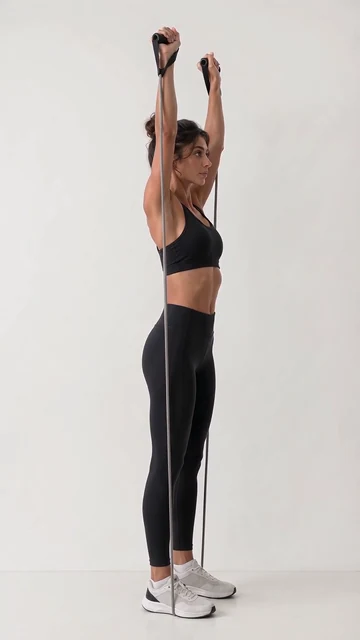
The faults a trainer sees most
The cues in quotes are the words Brad Glaser uses with his own clients.
What you see: The ribs flare and the low back sways to get the weight up.
The fix: "Tuck it", "abs tight", squeeze your glutes. Lighten the weight or press seated with your back supported.
What you see: The chin juts out at the top.
The fix: "Head back", "chin in". Push your head through the window your arms make.
What you see: The shoulders climb to the ears.
The fix: "Drop the traps." Press up while your shoulder blades stay down.
What you see: The weight finishes in front of your face, not over your head.
The fix: Press straight up so the weight ends stacked over your shoulders.
Move within a range that feels comfortable, and stop any exercise that hurts. Have a health condition, or been inactive a while? Ask your doctor what is right for you first. VeraForma is coaching, not medicine. It does not diagnose, treat or cure anything, and it does not replace your doctor or physio.
Prop your phone up and train. VeraForma's camera draws the line on your body and names what it sees, with the number it measured.
Free: your reps counted out loud, and the common standing faults shown right on screen, with the fix in your set report. Go Premium and it speaks the fix while you move: "Knees out." "Chest up."

Scan to open it on your phone.
Free: your movement screen, Phase 1 of your programme and all of nutrition.
He owns a personal-training studio in Southern California. The same method he uses standing next to a client, built into the app.
Scan to open it on your phone.
Free account, no card. Brad's questions. One squat on camera. Then your results.