
The training app for people who sit all day
A new desk set-up didn't lower the odds of neck pain. Exercise did.
VeraForma builds the corrective kind, from your own posture and movement screen.
And in trials, exercise cut the risk of a new bout of low-back pain by about a third.

- Snap your standing posture and see every lean marked up on your own photo, with the angle measured.
- The tight muscles and the weak muscles behind each fault, named.
- No time? Pick a 15-minute session, and set move-break reminders on your workday clock.
VeraForma is coaching, not medicine. It does not diagnose, treat or cure anything. Check with your doctor before you start, and first if you have numbness, pain that travels down an arm or leg, or pain that wakes you at night.
Standing posture · side
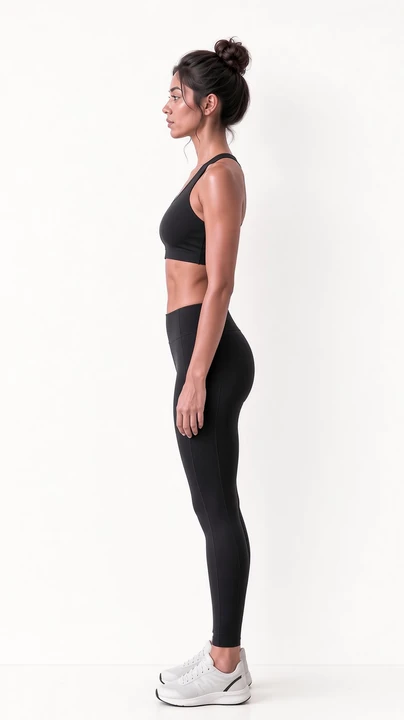
This demonstration features a synthetic performer: Merissa, VeraForma's AI-generated fitness model.
What the research says
Back pain is one of the most common health problems there is.
-
3 in 10
workers spend most of the workday sitting.
US 30.3% (BLS, 2025) · Europe 28% (EWCS, 2015) -
39%
of US adults had back pain in the last three months.
CDC, NCHS Data Brief 415 (2019 data) -
619 million
people worldwide had low-back pain in 2020.
GBD 2021, Lancet Rheumatology 2023 -
27–48%
of workers had neck pain in a year, depending on the country.
One review: Côté et al., Spine 2008
The part nobody tells you
Back pain tends to come back.
Two research teams, fourteen years apart, open with the same warning: back pain recurs, and the recurrences are a big part of what it costs people.Choi et al., Cochrane 2010 · Pocovi et al., Lancet 2024
Chair or training?
Can't quit your desk job? You don't have to.
Reviews did not find that sitting at work, on its own, causes low-back pain.Roffey et al., Spine J 2010 · Chen et al., Int Arch Occup Environ Health 2009
What moved the numbers in trials was not the workstation. It was exercise.
New bouts of pain, compared with people given no programme
-
Ergonomic programmes · new neck pain 1.00 · de Campos 2018
-
Exercise · new neck pain, mostly office workers 0.49 · Teichert 2023
-
Exercise · new neck pain 0.32 · de Campos 2018
-
Exercise · new low-back pain 0.67 · Shiri 2018
-
Exercise · new low-back pain 0.65 · Steffens 2016
-
Exercise · new low-back pain 0.59 · Huang 2020
| What was tried | Outcome | Ratio (95% interval) | Review |
|---|---|---|---|
| Ergonomic programmes | New neck pain | OR 1.00 (0.74–1.35) | de Campos 2018 |
| Exercise | New neck pain | OR 0.49 (0.31–0.76) | Teichert 2023 |
| Exercise | New neck pain | OR 0.32 (0.12–0.86) | de Campos 2018 |
| Exercise | New low-back pain | RR 0.67 (0.53–0.85) | Shiri 2018 |
| Exercise | New low-back pain | RR 0.65 (0.50–0.86) | Steffens 2016 |
| Exercise | New low-back pain | OR 0.59 (0.36–0.92) | Huang 2020 |
"I already bought the good chair."
Keep it. Just don't count on it: changing the workstation or the way people sit didn't lower the odds of new neck pain in the reviews above. Exercise did.Côté et al., Spine 2008 · de Campos et al., J Physiother 2018
Step 1 · See it
Two photos. Your posture, in degrees.
-
Standing. Standing posture from two photos, marked up with the angle of each lean measured.
Free -
Seated, at your desk. It screens your seated posture too.
Free -
Your pattern, named. Instead of a list of random faults, you get the pattern behind them, with what to loosen and what to wake up.
Free
"I don't trust a camera to read my posture."
You don't have to take its word: you get the angle it measured, drawn on your body. And the camera reads you on your phone.
Your posture pattern
Head forward, shoulders rounded
Named for you, with what is behind it
Release these
- The tight muscles behind a forward head and rounded shoulders, each one named on your card
Wake these up
- The weak ones that let the mid-back go quiet, each one named
Step 2 · Train it
Release what's tight. Strengthen what's weak.
Premium turns what your screen finds into a routine that loosens what's tight and wakes up what's weak.
-
Built into every session. Your corrective routine is part of every session, built from your screen.
Premium -
The desk drills, picked for you. Your routine picks the drills your desk day calls for.
Premium -
Five minutes counts. Pick the days, the time, and 5, 10, 15 or 20 minutes.
Premium -
Strength training, free. A programme built around your week: 2 to 7 days, at your level. Phase 1 is free for as long as you want it.
Free
"I already stretch."
Good. Stretching loosens the tight side. This routine wakes up the weak side too.
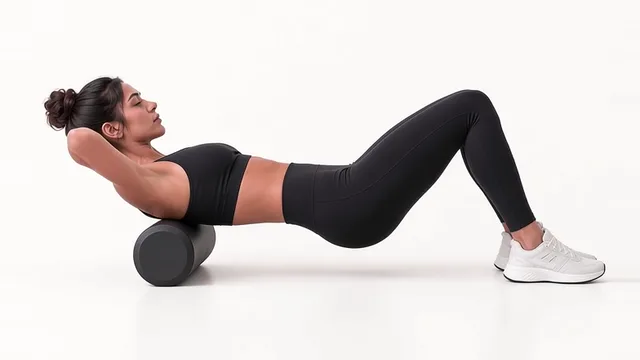
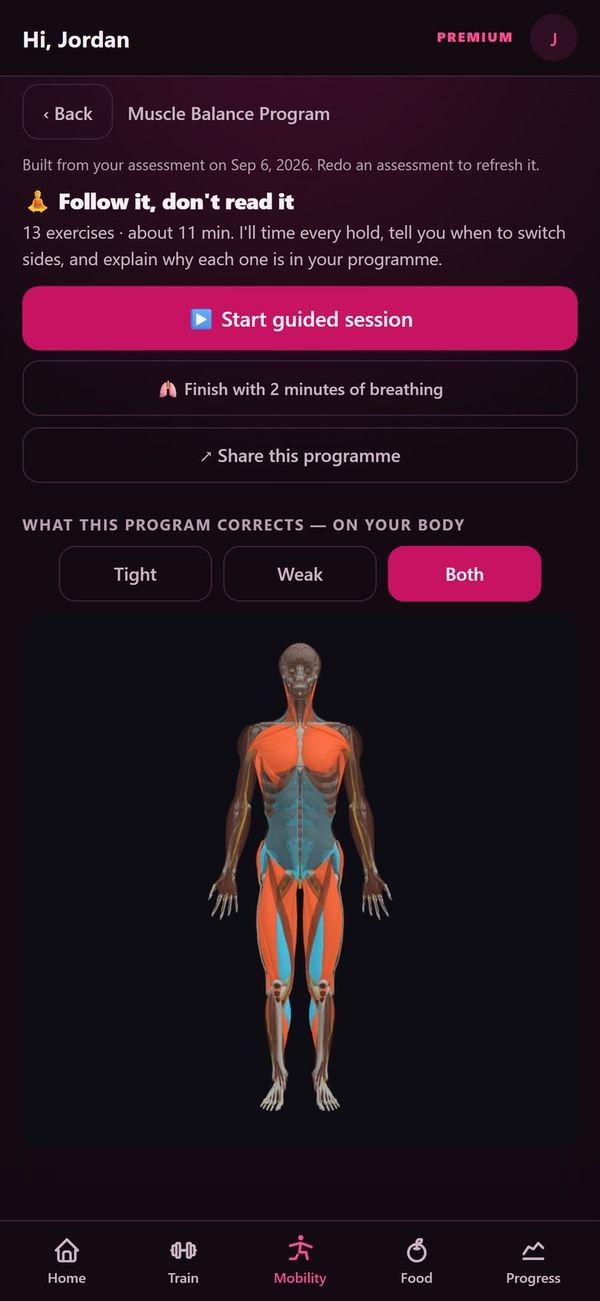
Real app screen, demo account. Premium
Your movement screen and Phase 1 are free, for good.
Step 3 · Keep at it
Re-screen. Keep what you built.
-
Re-screen as you go. Re-screen as you go and see exactly what changed.
Free -
Drills that ease off, and come back. Drills ease off as you improve, and step back in if something slips.
Premium -
Get up on a schedule. Move-break reminders on your workday clock, only between the hours you set.
Free -
Posture school. Six short lessons, including your desk set-up, so you know what good posture looks and feels like on you.
Free
How to actually sit. Tell the lesson about your day at the desk, and it shows you how to sit for it, with the reason behind each cue. Free
"Won't it just come back?"
In people who had already had back pain, exercise programmes halved the rate of recurrences at one year, and a walking-and-education programme nearly doubled the time to the next bout: 208 days against 112.Choi et al., Cochrane 2010 · Pocovi et al., Lancet 2024
What VeraForma adds: re-screens that show what changed, and drills that come back the moment a fault slips.
Already sore?
Back, neck or shoulder history? Mark it once. It trains around it.
Joint pain: train around it, and correct what's behind it. Every workout works around the old injury; Premium's Muscle Balance Program corrects the imbalance behind it, which can alleviate the pain.
Nerve pain like sciatica: your plan is built around it. Coaching, not medicine.
-
Mark it once. Note the old injury on your evaluation, and the programme trains around it.
Earned back, in steps. Your training around it builds back at your body's pace.
Free -
Something hurts today? Tell it, and today's session trains around it, or tells you it is one for a doctor or physio first.
It knows when to stop. It tells you straight when something is one for a doctor first.
Free
-
Bring your physio in. A one-page report for your physio, free.
Free -
Ask the trainer. Premium + members message Brad directly. It goes to him, not a bot.
Premium +
Have back, neck or shoulder pain, or a condition you're being treated for? Check with your doctor before you start.
VeraForma is coaching, not medicine. It does not diagnose, treat or cure anything, and it does not replace your doctor or physio.
Built by Brad Glaser · NASM Master Trainer · NASM-CPT, CES, PES · 20+ years · has certified 100+ personal trainers.
He owns a personal-training studio in Southern California. The same method he uses standing next to a client, built into the app.
Questions
Straight answers.
My back already hurts.
Then it trains around it. Mark the old injury once, and the programme trains around it.
Sore today? Tell it, and today's session trains around it, or tells you it is one for a doctor or physio first.
VeraForma is coaching, not medicine. It does not diagnose, treat or cure anything, and it does not replace your doctor or physio. Check with your doctor before you start.
I have no time.
Your corrective routine runs 5, 10, 15 or 20 minutes, on the days and at the time you pick. Premium
Short on time? Pick 15, 20 or 30 minutes and see today's trimmed list before you start.
Move-break reminders come on your workday clock, only between the hours you set.
I can't stop sitting. It's my job.
You don't have to stop. Reviews did not find that sitting at work, on its own, causes low-back pain (Roffey 2010; Chen 2009).
What lowered the risk of a new bout in trials was exercise: about a third fewer new bouts of low-back pain (Shiri 2018; Steffens 2016; Huang 2020).
That's what VeraForma builds into your week: your corrective routine runs 5, 10, 15 or 20 minutes, on the days and at the time you pick. Premium
I'll get hurt.
Mark the old injury once, and the programme trains around it, building back at your body's pace.
Prop your phone up. The camera watches your set, names what it sees with the number it measured, and draws the line on your body. With Premium, it speaks the fix while you move.
Something hurts today? Tell it, and today's session trains around it, or tells you it is one for a doctor or physio first.
I'm too old, or too out of shape, to start.
You're not. Phase 1 starts where you are, and it's free for as long as you want it.
A handful of quick strength checks show where you're strong and where you're lagging, so you train the part holding you back.
I tried a stretching app. It didn't stick.
This isn't a stretching app. Premium turns what your screen finds into a routine that loosens what's tight and wakes up what's weak.
Your corrective routine is part of every session, built from your screen.
Re-screen as you go and see exactly what changed.
My doctor handles my back.
Keep your doctor in charge.
Doctors' guidelines recommend exercise as an early, non-drug choice for long-term low-back pain (American College of Physicians, 2017; Lancet low-back pain series, 2018).
Bring them in: a one-page report for your physio, free.
VeraForma is coaching, not medicine. It does not diagnose, treat or cure anything, and it does not replace your doctor or physio.
What does it cost?
Free: unlimited movement screens, your standing and seated posture photos, Posture school, move-break reminders, Phase 1 and all of nutrition.
Premium adds your corrective programme, with the techniques and doses, and every phase after Phase 1, rebuilt from your latest screen.
Premium: $29.99 a month, or $249.99 a year (save 30%).
A trainer once a week runs about $238 a month. Premium is with you every workout, not one hour a week.
Get Premium here with a card, or in the Android app through Google Play.
Is the camera private?
The camera reads you on your phone. Your form-check video stays on your phone unless you choose to send it.
Progress photos stay on your phone unless you choose to post one to the wall or attach one to a bug report.
Android, web or iPhone?
All three.
Get the Android app on Google Play. On an iPhone or a computer, open veraforma.app in your browser and start today.
The App Store app is in Apple's review.
Your desk isn't going anywhere. Train for it. Start free.

Scan to open it on your phone.
Free account, no card. Brad's questions. One squat on camera. Then your results.
VeraForma is coaching, not medicine. It does not diagnose, treat or cure anything. Check with your doctor before you start, and first if you have numbness, pain that travels down an arm or leg, or pain that wakes you at night.